Week 4 – Invention, Intellectual Property, and Income
Overview
This week, we were asked to develop a dissemination plan for the final project, and to prepare a summary slide and short video. During the lecture, Ivan taught us about intellectual property, copyright, and licensing.
Purpose of Dissemination
Although my final project is still in its initial planning stage, it is a good idea to develop a plan now on how I wish to raise awareness about it for people or groups who may be interested in it. This will let me think about the exact reason that I am building this project, which will help when planning the next stages. This plan and my wish of how to use and distribute it will not likely remain the same in the future, but having a plan from the beginning will allow me to get started with a strong foundation.
Target Audience
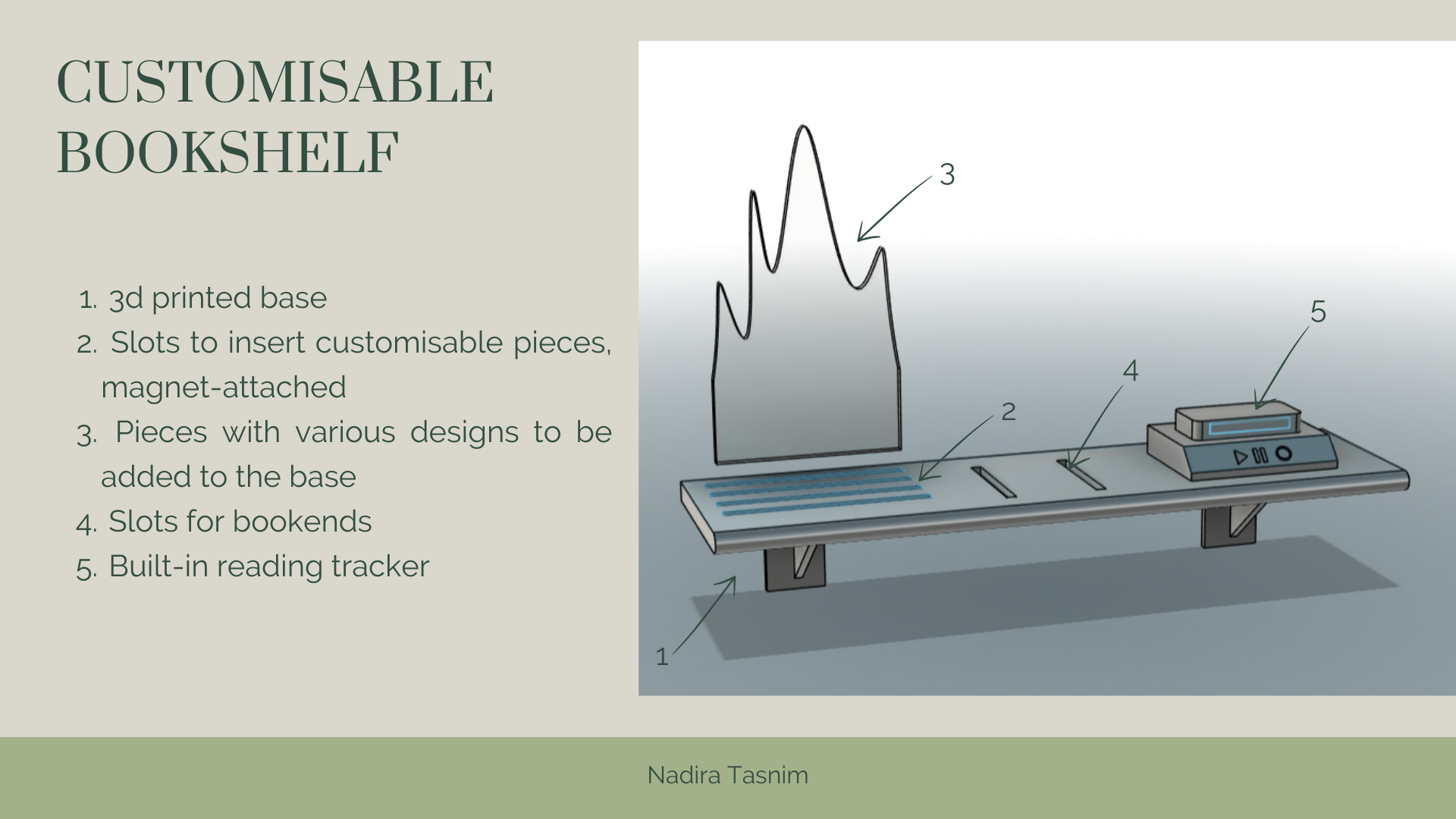
The idea for this Build Your Own Bookshelf stems for my love for books and anything bookish. Buildable bookshelves are definitely not new; however, the core idea of this project is the ability to customise your own bookshelf following a particular theme of your liking. My idea is to include multiple pieces that can be fitted into the slots, with 2-3 pieces belonging to a certain theme. Users can mix and match them as they wish.
I'm quite uncertain about the idea of a reading tracker on the shelf. It would be complicated if I wanted to log hours for each book, but if just for overall hours, I think it could be easy to implement.
Finally, the bookshelf definitely won't be very economical in terms of space. It is more about the aesthetic beauty it brings to your room rather than the number of books it can store.
Keeping all of the above in mind, the people/groups who might be interested in this project would be:
- DIY furniture enthusiasts
- Bookworms who love collecting bookish gadgets
- Students learning digital fabrication
- School or community workshops
Future Development
It's quite hard to come up with ideas of future development when the present doesn't exist. But if the project goes according to plan and I am able to implement everything succesfully, here are some ways I may want to improve the project in the future:
- Instead of a solid base, have multiple structures that can be pieced together. If possible, there may even be more than one way the base can be built.
- Improve the reading tracker to be able to log books.
- Develop a mobile app to store the reading tracker data.
- Make bigger versions to allow for more books and more customisation.
Licensing
At the moment, I am choosing to license my project under the Creative Commons Attribution–NonCommercial– 4.0 International License (CC BY-NC 4.0).
- Attribution (BY) - You must give appropriate credit, provide a link to the license, and indicate if changes were made. You may do so in any reasonable manner, but not in any way that suggests the licensor endorses you or your use.
- NonCommercial (NC) - You may not use the material for commercial purposes.
I chose this option to encourage open learning and knowledge sharing. The CC BY-NC 4.0 license allows others to study, modify, and build upon the bookshelf design for educational and personal purposes, provided proper credit is given.
For the software part of the project, including any scripts or application code, I am choosing the MIT License, which allows others to use, modify, and distribute the code freely while maintaining proper attribution.
Dissemination Plan
Once the final project is completed, I will have to think about how to offer it to its intended audience. Selling the product as a kit is an option, and if possible, there will be a few different types of kits to appeal to a wide variety of users. This would be good for anyone who wants the final product and is not interested in the fabrication process or does not have access to a digital fabrication lab.
At the same time, the project will be fully accessible through this website with detailed fabrication files, models, and assembly instructions for anyone who wishes to build the project independently. I would also like to create a downloadable and printable manual to make the process clearer and more user-friendly.
While the documentation will remain openly accessible, an additional potential revenue stream could come from organising guided workshop sessions, wherein participants will be introduced to the full workflow. In the future, I would love to collaborate with schools, makerspaces, or fabrication labs to deliver these sessions. Beyond financial benefit, this approach will allow me to share my passion for design and books and gain recognition within the digital fabrication community.
Sharing My Work
The idea for the project grew from my love for books, and I'd love for it to reach more people who share my interests. I see it as a way to connect creativity, reading culture, and digital fabrication. By documenting it openly, I hope the project serves as inspiration for students exploring design.
I plan to continue developing this website to ensure the documentation is clear and easy to replicate. I would also like to create a simplified version of the design for beginners who are just starting their fabrication journey.
To reach a broader audience, I intend to share the project within online bookish communities, through, for example, YouTube or Reddit. Once it is completed, I would love to present the project in schools or workshops to encourage learning digital fabrication. Documenting the fabrication process in online platforms may be a good way to reach the intended audience who will be there when the final product is eventually created.
Project Video and Summary Slide